
Digital dexterity is the workforce capability to not only operate digital tools, but to learn unfamiliar platforms quickly, combine them creatively, and drive better outcomes without waiting for IT support. It goes beyond digital literacy (the ability to use given tools) to include cognitive agility, technical self-sufficiency, and data fluency.
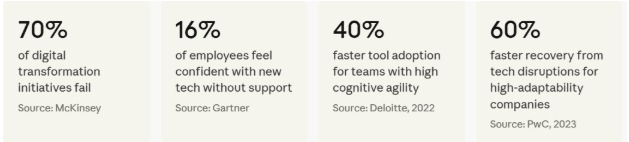
Most organizations have spent the last decade buying software licenses, hiring consultants, and rolling out training decks — and yet roughly 70% of digital transformation initiatives still fail, according to McKinsey. The missing ingredient isn’t better technology. It’s the human capacity to use it well.
Why do 70% of digital transformation efforts fail?
Most transformation programs are top-down, IT-driven, and built around a single rollout event. They invest heavily in technology but underinvest in the human skills needed to use it. According to Gartner, only 16% of employees feel confident using new workplace technology without support — meaning the vast majority revert to old habits and use fewer than 20% of a tool’s capabilities.
What is the difference between digital literacy and digital dexterity?
Digital literacy means an employee can use the tools they have been given — navigating a CRM, submitting a report, or joining a video call. Digital dexterity goes further: it is the ability to learn unfamiliar tools quickly, combine platforms in unexpected ways, and solve problems that were never covered in training. The analogy is the difference between a cook who follows a recipe and one who can open a fridge, assess what is available, and improvise a meal.
The Three Core Pillars of a Dexterous Workforce
- Cognitive agility — the ability to approach unfamiliar workflows with curiosity, identify where they break down, and experiment with tools to fix them. Trainable, not a fixed personality trait. Teams with high cognitive agility adopt new tools 40% faster (Deloitte, 2022).
- Technical self-sufficiency — the capacity of non-IT departments to handle routine tasks: building forms, creating workflow triggers, connecting apps via integration platforms. Organizations that distribute technical skills report 30–50% faster project completion for internal improvements.
- Data fluency — the ability to read, interpret, and act on data without a data scientist intermediary. Data skills rank in the top five most in-demand capabilities across every industry (LinkedIn Workplace Learning Report).
Cultivating a Culture of Continuous Experimentation
How to reduce fear of failure with new technology
The structural fixes that work include: creating sandbox environments where employees can test tools without affecting production systems, allocating dedicated exploration time (even a few hours per month), and celebrating failed experiments as publicly as successful ones. Companies like Google have shown that even modest allocations of experimentation time produce outsized returns.
Employee-led innovation as a dexterity engine
The best ideas for technology use often come from people closest to the work. A customer service rep handling 50 tickets daily spots automation opportunities a process consultant would miss. Siemens runs internal “innovation challenges” where any employee can pitch a tech-enabled workflow improvement — winning ideas receive funding to implement.
Infrastructure That Supports Human Flexibility
What are low-code and no-code platforms, and why do they matter for digital dexterity?
Low-code and no-code platforms — such as Airtable, Zapier, Microsoft Power Apps, and Retool — allow non-technical employees to build automations, dashboards, and workflows without writing code. Forrester Research found these platforms reduce application development time by 50–90% for common use cases. More importantly, they shift employees from passive technology consumers to active builders — a mindset shift that is central to developing digital dexterity at scale.
Measuring Adaptability, Not Just Adoption
Traditional IT metrics — adoption rates, tickets closed, licenses utilized — do not capture dexterity. The following metrics better reflect workforce adaptability:
| Metric | What it measures | Why it matters |
| Time-to-proficiency | How quickly employees become productive on a new tool | Tracks whether dexterity is improving over time |
| Cross-tool usage | Whether employees combine multiple platforms to solve problems | Identifies silos vs. integrated workflows |
| Employee-initiated automations | Process improvements originating from non-IT staff | Signals distributed technical capability |
| Recovery time after disruption | Speed at which productivity returns after a platform migration | PwC (2023): high-adaptability companies recover 60% faster |
If you’re looking for a workspace that reflects this kind of forward-thinking approach, WorkSocial in Jersey City offers purpose-built professional environments designed for teams that need flexibility, collaboration infrastructure, and room to grow. It’s worth checking out their shared office spaces if you’re rethinking how your physical environment supports the way your team actually works.
The question isn’t whether your organization needs more digital dexterity. It does. The question is whether you’ll build it deliberately or keep hoping the next software purchase will finally be the one that changes everything. Spoiler: it won’t. Your people will.